Phishing testing
We run controlled phishing simulations to see how your employees respond to cyberattacks
What does phishing testing involve?
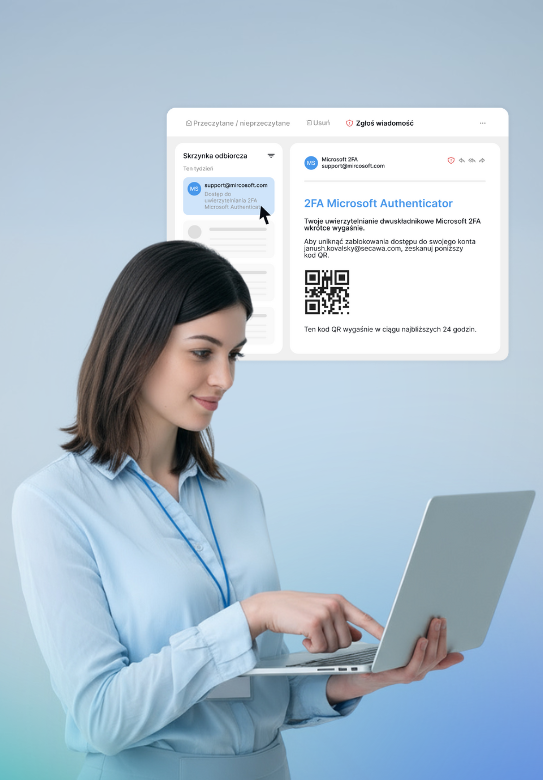
- Link: checking reactions to clicking and the user’s subsequent actions.
- Attachment: checking the tendency to open a file.
- Login page: determining what proportion of the team enters data on a fake page.
- Spear phishing: scenarios tailored to specific roles or departments.
It is worth conducting phishing tests regularly, for example quarterly or every six months, when you want to assess your team’s susceptibility to cyberattacks. Consider Practical Anti-phishing Trainingwhich involves regularly sending simulated cyberattacks to employees. This develops safe habits that protect the whole company.
What will you gain from phishing testing?
We also provide recommendations for further action: improvements to security procedures and security awareness programs that can reduce susceptibility to cyber threats and strengthen your company’s security.
Our certifications







Why carry out
phishing tests?


How does phishing testing work?
Learn how we conduct phishing tests that reveal your team’s susceptibility to manipulation and support effective improvements to security procedures.
Learn how we conduct phishing tests that reveal your team’s susceptibility to manipulation and support effective improvements to security procedures.
Planning

Scenarios

Phishing testing

Analysis and report

Read what customers who trusted us have to say
Would you like to run a phishing test with no cost or obligation?
- You will assess employees’ resilience to phishing.
- You will check the results of your previous educational activities.
- You will see how we conduct phishing tests and learn about our proprietary cyberattack simulation platform.
- We will discuss your individual needs in building cyber resilience.

Why entrust us with phishing testing?
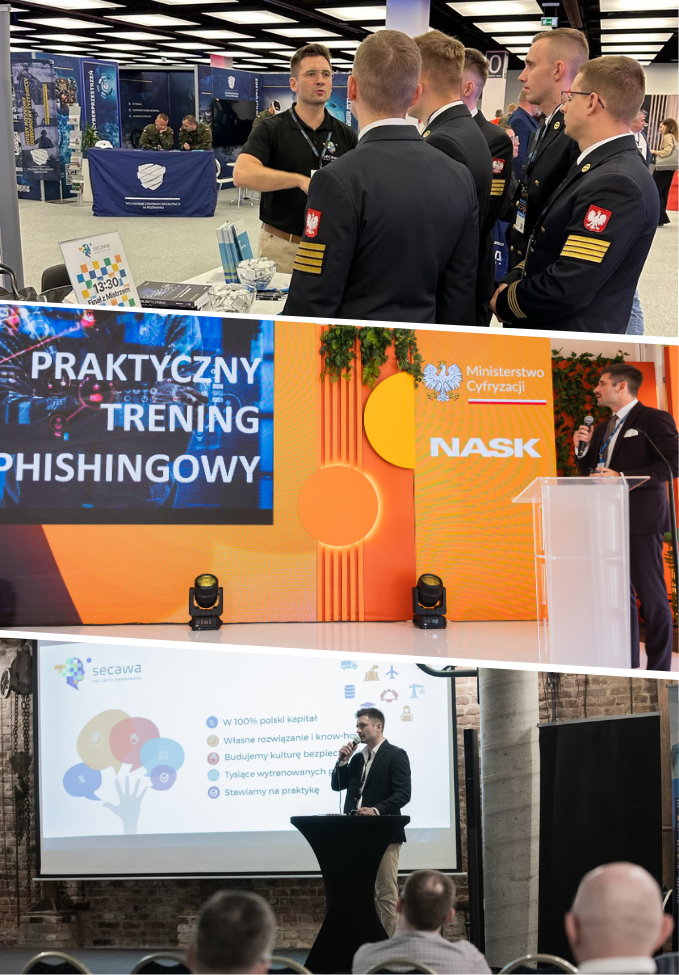
We develop our proprietary training platform and support cybersecurity in Poland as a PWCyber partner and donor to the CISO #Poland Foundation.



Frequently asked questions
The cost of phishing testing depends on the campaign’s scope and the expected level of scenario customization and reporting. Pricing is therefore agreed individually after a brief discussion of the scope.
The cost depends on the number and complexity of scenarios, from a single campaign to several variants for different roles, as well as the number of employees and any segmentation into departments or user groups.
Pricing also covers the reporting method and report type, such as operational, CISO or management reports, and how the results will be presented: remotely or on site, and to which audience.
If the test includes OSINT, its cost depends on the scope and objective of reconnaissance: supporting the scenarios or providing a full analysis of organizational exposure.
Please contact us. After a brief scope discussion, we will prepare a phishing-testing quote and recommend an appropriate option.
Our team prepares and verifies the scenarios. The simulations do not compromise your systems or data. Attachments are harmless and used only to detect behavior and educate employees. Login-form data is captured in a controlled way: we anonymize it or, optionally, encrypt it with your public key so that only you can access it.
We analyze your structure, industry and Polish business context; use OSINT; and monitor APT group activity and current campaigns. We adapt to your environment, including brands, processes and internal communication. Over time, we focus on the vectors to which your team is most susceptible to reduce the impact and likelihood of a successful real attack.
Yes. During the test, you receive access to our proprietary platform with a live dashboard showing reactions, such as who fell for a simulation, progress and results throughout the campaign.
A professional summary analyzing the simulation: employee reactions, time to the first mistakes and a benchmark against organizations with a similar profile. The material is suitable for presenting to management and planning next steps.
Phishing tests should be conducted regularly, for example quarterly or every six months. If you want to improve your team’s resilience, we recommend complementing them with our Practical Anti-phishing Training.
We agree this together. A test can cover selected groups, such as high-risk departments, or a larger part of the organization so that the results are representative.
The simulation takes place in normal working conditions and is designed to avoid disruption, with ethical content and controlled intensity.
Yes. You can start with a Free Phishing Test, in which we conduct one phishing simulation for a selected group of employees at no cost and with no obligation.
In many organizations, cybersecurity relies on technological safeguards, but people can still be the quickest route to an incident. Phishing exploits haste, routine and trust. Even good safeguards will not prevent the consequences if an employee clicks a link or discloses sensitive data. This is where activities that strengthen users’ security awareness are needed.
What are phishing tests?
Phishing tests are controlled simulations of phishing attacks that assess how company employees respond to realistic messages. Their purpose is to measure phishing risk and identify weaknesses within the organization. Phishing tests assess employee awareness, resilience to real threats and whether security procedures work in practice.
What do phishing simulations measure, and why does it matter?
A well-designed campaign considers not just a click but the entire chain of behavior: responses to a message, vigilance, login attempts and whether security incidents are reported as agreed. Phishing tests help assess phishing risk, identify employee vulnerabilities and check whether security procedures are understood and followed. They also provide a starting point for incorporating phishing tests into a wider security awareness program so that improving employee awareness has a measurable effect. Phishing tests also allow comparisons between groups and reveal where phishing risk is greatest.
Which variants do phishing simulations cover?
For a reliable assessment, attack scenarios must resemble the communication employees encounter every day. Phishing testing therefore uses different variants, from classic lures to more tailored approaches. Spear phishing is increasingly relevant: scenarios targeting specific roles, departments or processes.
Phishing as part of social-engineering testing
Phishing tests are part of the wider field of social-engineering tests in cybersecurity. Social-engineering tests focus on how people respond to manipulation and impersonation of trusted sources and phishing is the most commonly used technique. Depending on the organization’s needs, social-engineering testing can cover other communication channels, but this service focuses on phishing and its variants.
What do the test results tell us?
The test results reveal where the organization is most susceptible and whether the issue is clicking, disclosing data or failing to respond appropriately to a suspicious message. Simulations reveal differences between teams and roles and help assess whether previously implemented security awareness activities actually reduce risk. This supports a data-driven security strategy rather than one based on assumptions.How does phishing testing help improve organizational security?
Tests alone are a measurement, and measurement without action changes nothing. Phishing tests therefore lead to concrete action: what to improve in security procedures, where practical employee education is needed and which aspects of internal communication strengthen resilience. In practice, incorporating phishing tests into a security awareness program improves company security and personal data security by reducing the likelihood that phishing becomes an effective gateway into your infrastructure.
Regular phishing testing as part of Practical Anti-phishing Training
Regular phishing tests allow you to track trends, compare results and assess whether the changes you have introduced are actually working.
The best results come from combining regular tests with educational activities, which is why we recommend Practical Anti-phishing Training. This security awareness program makes phishing tests part of a process: we run regular simulations, measure user behavior and follow them with short, practical education at the moment of a mistake. As a result, improving employee awareness is no longer limited to occasional “cybersecurity training ” but becomes an integral part of security culture, measurably reduces employee susceptibility and teaches people to recognize potential threats quickly and respond appropriately.
Phishing testing, compliance and information security
For many organizations, testing is also part of their audits. Conducting phishing tests helps demonstrate security awareness activities, which matters in the context of requirements such as GDPR (RODO), DORA, NIS-2 and ISO 27001. Well-documented information security activities help reduce the risks of sensitive or personal data leaks and the disclosure of confidential information, while supporting a consistent approach to data protection.